Multi Vendor Network Configuration Management: Managing Cisco, Juniper, and Fortinet Together
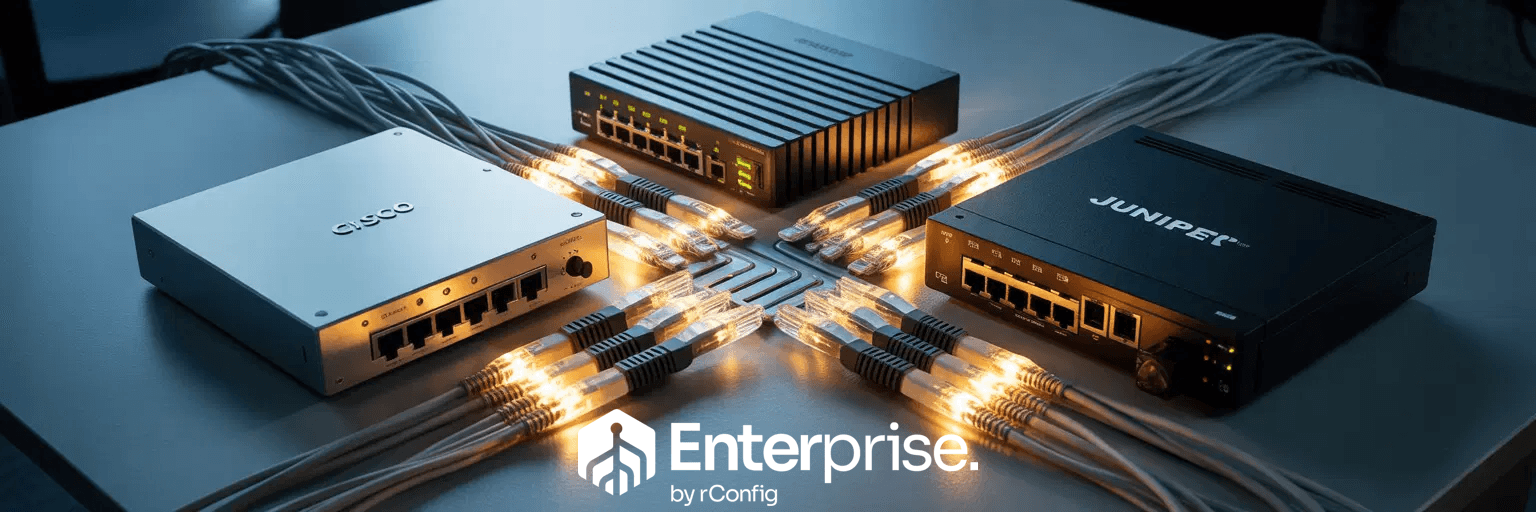
The decision to build a multi-vendor network goes beyond simple business logistics. It's often driven by specific technical requirements. For instance, an organization might rely on Cisco for its robust core campus switching, leverage Juniper for its high-performance edge routing, and deploy Fortinet for its next-generation firewall security. Each choice is optimal for its specific function, creating a powerful, specialized infrastructure. This approach delivers a significant strategic advantage, but it comes with a steep management cost.

The Inevitable Complexity of Modern Networks
Let's start with a truth every CTO knows: no large network is built from a single vendor. Mergers, acquisitions, and strategic 'best-of-breed' technology choices inevitably lead to a mix of hardware from vendors like Cisco, Juniper, and Fortinet. This reality isn't a mistake, it's a reflection of strategic decision making. The real challenge, however, is the operational friction that arises from managing these powerful but disparate systems together. This article provides a clear framework for achieving unified and automated multi vendor network configuration management, turning a complex environment into a strategic asset.
The Reality of a Multi-Vendor Infrastructure

The decision to build a multi-vendor network goes beyond simple business logistics. It's often driven by specific technical requirements. For instance, an organization might rely on Cisco for its robust core campus switching, leverage Juniper for its high-performance edge routing, and deploy Fortinet for its next-generation firewall security. Each choice is optimal for its specific function, creating a powerful, specialized infrastructure. This approach delivers a significant strategic advantage, but it comes with a steep management cost.
The primary pain point is the absence of a single, unified management interface. Network engineers are forced to juggle multiple consoles, command sets, and operating philosophies. This fragmentation complicates routine tasks like VLAN provisioning or access control list updates, turning simple changes into time-consuming projects. More importantly, it slows down critical security patching and increases the operational risk of misconfiguration. The lack of a cohesive view makes true multi vendor network management feel less like a strategy and more like a daily struggle against complexity.
Deconstructing Vendor CLI and API Differences
The root of the management challenge lies in the fundamental differences between network operating systems, particularly their Command Line Interfaces (CLIs). These are not just minor syntax variations, they represent entirely different philosophies of network administration. The constant context-switching required to manage these systems places a high cognitive load on engineers and dramatically increases the potential for human error. This is the core of the CLI diversity problem.
Consider the contrast between Cisco IOS and Juniper Junos. With Cisco, every command is executed immediately, making changes live the moment you press enter. It’s direct and immediate. Juniper, on the other hand, uses a hierarchical, candidate-and-commit model. Engineers build a candidate configuration in a sandbox, review it for accuracy, and then apply it atomically with a single 'commit' command. This prevents partial configurations from going live. Then there's Fortinet's FortiOS, which often uses an object-oriented approach, where policies and interfaces are treated as configurable objects. These vendor differences mean that a simple task requires three distinct mental models and workflows. This complexity extends to their APIs and data models, making effective cross vendor configuration management nearly impossible without a dedicated abstraction layer.
| Vendor OS | Configuration Philosophy | Typical Workflow Steps |
|---|---|---|
| Cisco IOS | Immediate Execution | Enter global config mode, create VLAN, name it, exit. Changes are live instantly. |
| Juniper Junos | Candidate & Commit | Enter edit mode, define VLAN hierarchy, review changes, commit. Changes are atomic. |
| Fortinet FortiOS | Object-Oriented | Navigate to network interfaces, create new VLAN interface, assign to physical port and virtual domain. |
Strategies for Standardizing Configuration Management

After understanding the root causes of multi-vendor friction, we can move toward a solution. The first and most critical step is configuration standardization. This isn't about forcing every device to behave identically, but about creating a unified policy and intent layer that sits above the vendor-specific syntax. A successful strategy involves three key actions:
- Define 'Golden Configuration' Templates: Establish baseline configurations for different device roles (e.g., access switch, core router, perimeter firewall). These templates should enforce security policies, compliance requirements, and operational best practices, serving as the verifiable source of truth for how a device should be configured.
- Abstract Policies from Commands: Shift the focus from the 'how' (the specific CLI syntax) to the 'what' (the business intent). Instead of writing a script to configure NTP on a Cisco switch and another for a Juniper router, define a single policy that states "all network devices must sync to these NTP servers."
- Implement a Vendor-Agnostic NCM Tool: This is where abstraction becomes reality. A powerful network configuration manager translates your abstract policies into the native CLI required by each device. It becomes the engine that enforces your golden configurations across the entire infrastructure, ensuring consistency regardless of the vendor.
This approach dramatically simplifies audits. Instead of manually checking hundreds of disparate device configs, you audit against a small set of standardized templates, providing clear and consistent proof of compliance.
Overcoming Multi-Vendor Operational Hurdles
Without the standardization we just discussed, day-to-day operations in a multi-vendor environment become a series of recurring hurdles. These challenges directly impact efficiency, security, and the ability to innovate. They are the practical consequences of managing complexity without the right strategy and tools.
- Fragmented Troubleshooting: When a network issue spans devices from different vendors, diagnosis becomes a nightmare. Engineers must correlate logs in different formats, interpret vendor-specific error messages, and manually trace connectivity across systems with no common reference point. A simple outage can take hours or even days to resolve.
- Complex Firmware Management: Managing updates and security patches across multiple ecosystems is a high-risk, labor-intensive process. Each vendor has its own release cycle, vulnerability reporting, and upgrade procedure. Ensuring that every device is patched consistently and without causing unintended disruptions is a significant operational burden.
- Inconsistent Security Posture: The difficulty of deploying changes consistently means that urgent security patches are often applied unevenly. An access control rule might be correctly implemented on your Cisco switches but misconfigured on your Fortinet firewalls, leaving a critical security gap. This inconsistency undermines the entire security posture of the network.
These operational burdens are not just technical problems. They translate directly into wasted engineering hours, increased business risk, and a slower response to new business requirements.
The Central Role of Automation and NCM Platforms

Building on a foundation of standardization, network automation is the definitive solution to these operational hurdles. A modern, vendor agnostic NCM platform acts as the central nervous system for your entire network, providing the abstraction and control needed to manage a diverse infrastructure efficiently. It's the engine that drives consistency and reliability.
A comprehensive NCM platform delivers several critical capabilities through a single interface. It automates configuration backups, providing a safety net for every device. It offers real-time change detection, immediately alerting your team to any unauthorized or accidental modifications that could lead to an outage or security breach. It also runs continuous compliance audits, comparing live configurations against your golden templates and flagging any deviations for automated remediation. This platform becomes the crucial abstraction layer, allowing engineers to manage network-wide policies without getting bogged down in vendor-specific syntax. The return on investment is clear and compelling for any CTO: fewer human errors, faster service delivery, and the ability to free up senior engineering talent to focus on strategic initiatives instead of repetitive manual tasks.
Achieving Agnostic Management with the Right Architecture
The theory of a vendor-agnostic NCM is powerful, but its effectiveness depends entirely on the underlying architecture. A truly effective platform for multi vendor network configuration management must be built on an open and extensible framework. This is where a solution like rConfig demonstrates its value. Its open-source heritage is proof of a commitment to flexibility and community-driven support, ensuring it can adapt to new hardware and technologies.
The key to solving the CLI diversity problem lies in customizable device templates. This architecture allows the platform to communicate with any device that has a CLI, from mainstream vendors like Cisco and Juniper to more specialized equipment. Instead of being locked into a predefined list of supported devices, you can extend the platform's capabilities yourself. Features like bulk deployment and configuration analysis directly address the operational hurdles of patching and troubleshooting. This is how a platform designed for multi-vendor configuration management from the ground up connects strategy to execution. This flexible architecture supports a range of products we have developed designed for different scales of network operations, ensuring a fit for any environment.
Key Takeaways for Unified Network Management
Let's bring it all together. Multi-vendor networks are a strategic reality, not a problem to be eliminated. The complexity they introduce is manageable with the right approach. The solution rests on a three-pronged strategy: standardization to define intent, abstraction to hide complexity, and automation to execute reliably. A robust, vendor agnostic NCM platform is the essential enabler that brings these three elements together. For CTOs, achieving unified management is not just an operational improvement. It is a foundational step toward building an agile, secure, and scalable network that can support business goals for years to come.
Unify Your Network with a Demo
rConfig is purpose-built to solve the challenges of multi-vendor network management. Our platform's vendor-agnostic architecture and extensive multi-vendor support provide the unified control you need to manage your Cisco, Juniper, and Fortinet devices seamlessly. See how it works in your environment by requesting a personalized demo today.
About the Author
rConfig
All at rConfig
The rConfig Team is a collective of network engineers and automation experts. We build tools that manage millions of devices worldwide, focusing on speed, compliance, and reliability.
More about rConfig TeamRead Next

Beyond Brand Loyalty: The Tactical Shift to Vendor Agnostic Network Solutions

Vendor Agnostic Network Management: Why Enterprises Are Moving Away from Single Vendor Tooling